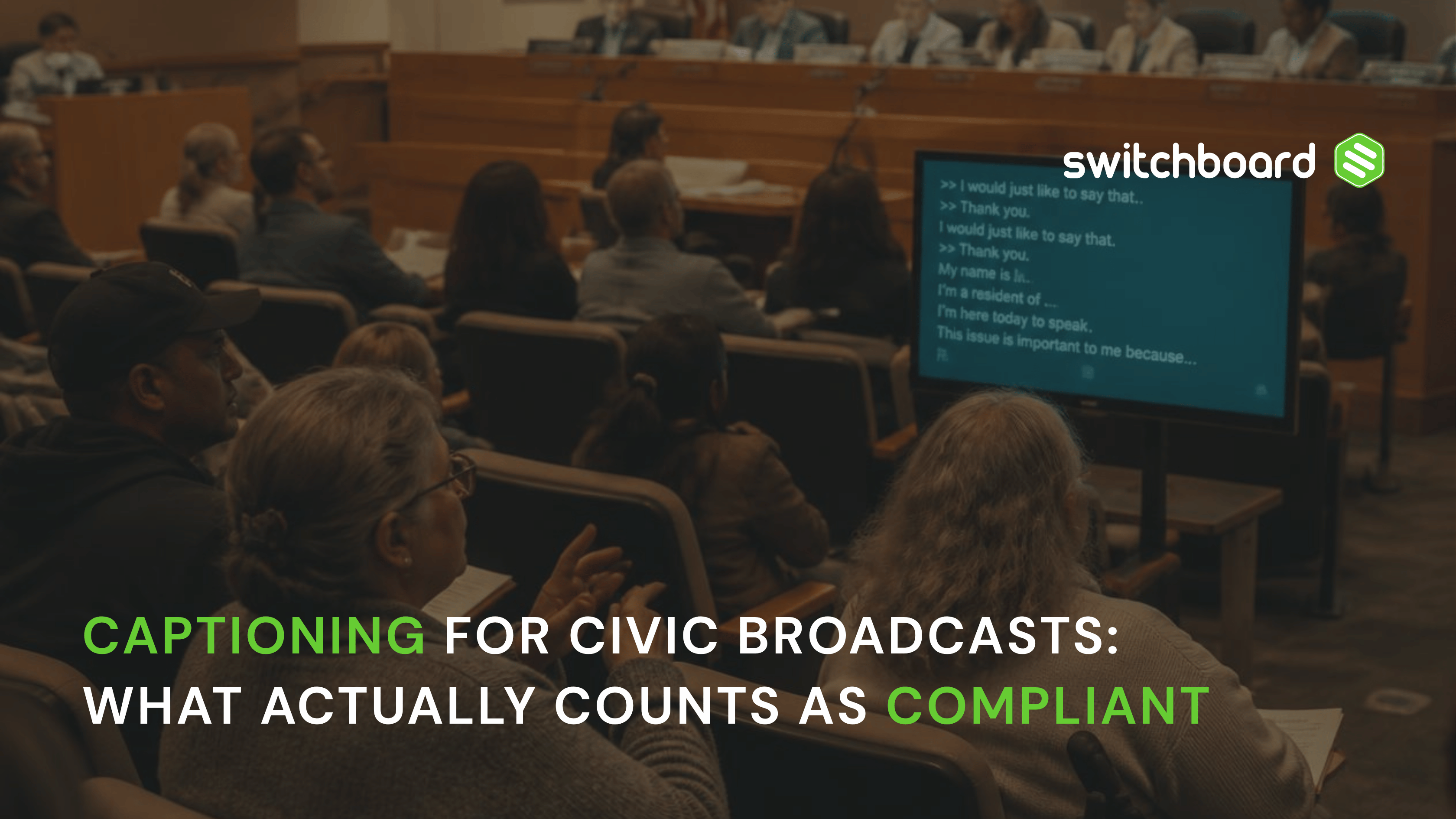
It is likely that your city council meeting has captions running. That does not mean the meeting is compliant.
Auto-generated captions satisfy almost nobody: not the deaf and hard of hearing residents trying to follow a budget vote, and not the accuracy standard federal law actually requires for live civic broadcasts. That gap between "there are captions" and "the captions are compliant" is where most municipalities currently sit. There is an assumption that compliant captions are expensive and difficult to implement, but closing this gap does not require a massive budget increase.
In fact, what you need may be simpler than it sounds. In this article, we'll walk you through understanding the legal requirements of compliant captions, why civic meetings are unique events that are particularly hard to caption, and more importantly, which tools make real compliance achievable for agencies of any size.
A Brief Overview of the Legal Bar
Title II of the ADA has required accessible government programs and services for decades. What has recently changed is the specificity. In April 2024, the Department of Justice issued a Final Rule adopting WCAG 2.1 Level AA as the enforceable technical standard for state and local government digital content, including live and archived video. Prerecorded meetings need accurate, synchronized captions. Live broadcasts, like a city council meeting or a budget hearing, need real-time captions that keep pace with what is actually being said.
In April 2026, the DOJ pushed the original compliance deadlines back by one year through an Interim Final Rule, citing widespread staffing shortages and the complexity of remediating legacy content.
This extra runway is useful, but it doesn't mean you should wait.
Why Civic Meetings Are Hard to Caption Accurately
Caption accuracy is not a fixed property of a tool. It depends heavily on what the tool is listening to. A quiet studio with one trained speaker and a good microphone is the best-case scenario for any automatic speech recognition system, and even there, accuracy tops out in the mid-80s for most tools.
A city council meeting is far from the ideal scenario for this technology:
- Multiple speakers talk over each other during debate
- Public comment periods bring unscripted remarks from residents with every kind of accent and speaking style
- Council chambers have hard surfaces that create echo
- Agendas are full of proper nouns automatic systems have never heard: street names, department acronyms, the names of every board member and department head
Under these conditions, automatic speech recognition accuracy commonly drops to the 60 to 70 percent range, even when the same tool tests well in a lab.
This is the part most compliance conversations skip. The format of the meeting is not incidental to caption quality. It is the single biggest variable. A tool that works fine for a quiet webinar can fail completely during a contentious zoning hearing with six people talking at once. Any captioning strategy that does not account for this will look compliant on paper but fail the people it is supposed to serve.
Automatic Captions Alone Do Not Meet the Bar
Automatic speech recognition, the technology behind YouTube's and Zoom's built-in captions, is not designed to guarantee accuracy under the conditions described above. Regulators, courts, and accessibility standards bodies are consistent on this point: unedited automatic captions are not, by themselves, a sufficient accommodation for live public proceedings under Title II.
Professional real-time captioning, known as CART, solves the accuracy problem with trained, certified stenographers who caption speech as it happens. CART consistently delivers accuracy in the high 90s, even with overlapping speakers and technical jargon, because a trained human can do what a model still struggles with: track multiple speakers, follow context, and catch the difference between "the city will fund this project" and "the city will not fund this project."
The tradeoff is cost. Remote CART typically runs $75 to $185 per hour depending on the vendor, complexity, and whether multilingual captioning is needed. For an agency running two or three meetings a week, every week, that adds up fast, and it is the reason so many municipalities default back to automatic captions they already suspect are not really compliant.
What This Actually Costs Communities
The financial exposure is real. Digital accessibility settlements involving captioning have climbed steadily, and enforcement against public entities has increased year over year. But the number that matters most is not a settlement figure. It is what happens when a resident who is deaf or hard of hearing cannot follow a zoning vote that affects their block, or a budget decision that affects their taxes.
Federal courts have weighed in directly on this point. In National Association of the Deaf v. Florida Legislature, the Eleventh Circuit affirmed that a resident's ability to monitor and participate in the actions of their elected representatives is tied to the fundamental right to participate in the democratic process. This is a perfect example of why captioning a public meeting is not a courtesy extended to a subset of residents. Rather, it's part of what makes the meeting public in the first place.
A less obvious cost shows up when agencies overcorrect. Facing litigation risk, some cities and universities have pulled entire archives of historical meeting recordings offline rather than pay to remediate them. That response satisfies a narrow reading of the law while doing real damage to public transparency. The goal is not to hide the archive. It is to build new content correctly going forward and use the ADA's narrow allowance for clearly labeled historical archives in the meantime.
None of this requires choosing between a compliance risk and a budget you do not have. The captioning market has changed substantially in the last two years, and the tools available to a mid-size city today are meaningfully better and cheaper than they were even three years ago.
The shift that matters most is the move toward hybrid captioning: automatic speech recognition doing the first pass, with human oversight layered in where it counts. Platforms like AI-Media's Smart LEXI and Verbit's Captivate use this model, combining domain-trained ASR with human correction to reach accuracy in the high 90s at a lower cost than full-time CART. StreamText, a captioning platform many event producers already use, now prices its AI tier at $0.27 per minute, meaning a standard hour-long meeting runs about $16 in captioning cost when the stakes do not call for a certified human captioner.
Routine, recurring meetings with a predictable agenda and familiar speakers are a reasonable fit for AI-assisted captioning with a custom vocabulary list built from your own agendas, street names, and staff names. The upfront work of building that list is what separates a captioning tool that struggles with your meetings from one that performs close to CART-level accuracy on your specific content.
High-stakes meetings, contentious hearings, budget votes, and anything likely to draw a large audience or press attention deserve professional CART or a premium hybrid tier with human review built in. This is where the cost of an error is highest and where residents are most likely to actually be watching.
None of this works if the underlying broadcast is not reliable in the first place. After all, a caption feed is only as good as the stream it rides on. This is where multistreaming solutions like Switchboard Live come into the picture: distributing your captioned feed simultaneously to YouTube, Facebook, your municipal website, and every other destination your residents actually use, so the accessibility work you have already paid for reaches the largest possible audience instead of a single platform.
Audit Your Current Setup: A Practical Starting Point
Before spending on new tools, most agencies benefit from a straightforward audit of what they already have.
- Pull three recent recordings, not your cleanest meeting. Choose ones with public comment, cross-talk, and at least one contentious agenda item.
- Check the actual caption accuracy against what was said, not the accuracy number a vendor advertises. Watch five minutes of dense discussion and count the errors that would change someone's understanding of what was decided.
- Separate your meetings into tiers. A recurring council session is not the same compliance risk as a public hearing on a rezoning that half the town is attending.
- Match your captioning approach to each tier. Automatic or hybrid AI for routine sessions, CART or premium hybrid for high-stakes ones.
- Build and maintain a custom vocabulary list for your agency: street names, staff names, department acronyms, and recurring procedural terms. Update it whenever your council or leadership changes.
- Confirm your broadcast has redundancy. A caption failure and a stream failure are both compliance problems, and both need a documented response protocol.
- Keep records. Save caption files alongside your meeting minutes. If your captioning practice is ever challenged, a documented, tiered approach is a materially stronger position than an undocumented one.
Frequently Asked Questions
Are YouTube's automatic captions ADA compliant for city council meetings?
Not on their own. Automatic captions can supplement a broadcast, but under WCAG 2.1 AA, live civic broadcasts require real-time captions that meet a much higher accuracy standard than unedited automatic speech recognition typically delivers, especially in a council chamber with multiple speakers and background noise.
What is the deadline for ADA Title II caption compliance?
Large municipalities and state agencies serving 50,000 or more residents have until April 26, 2027. Smaller municipalities and special districts of any size have until April 26, 2028, following a one-year extension the Department of Justice issued in April 2026.
How much does CART captioning cost for a government meeting?
Remote CART captioning generally runs $75 to $185 per hour depending on the vendor and complexity, with on-site services costing more. Many agencies now use CART selectively for high-stakes meetings and hybrid AI-assisted captioning for routine sessions to manage cost.
Can AI captioning meet ADA compliance requirements for public meetings?
Modern hybrid AI-plus-human captioning tools can reach accuracy levels close to professional CART for many meeting types, particularly when paired with a custom vocabulary built from an agency's own agendas and terminology. Fully automatic captioning without human oversight is generally not considered sufficient on its own for live civic broadcasts.
Why are automatic captions less accurate during public meetings than in other settings?
Caption accuracy depends heavily on audio conditions. Multiple speakers, overlapping cross-talk during public comment, room echo in council chambers, and specialized local vocabulary all reduce automatic speech recognition accuracy, sometimes to 60 to 70 percent, even when the same tool performs well in ideal conditions.
.png)