Municipal broadcasting does not accept do-overs. When signals drop, frames freeze, or audio slips out of sync during a city council vote, that failure is immediately and completely public. But a system that never fails is virtually unattainable, and not the mindset for successful operation. Rather, what you want to look for is a system that fails safely, absorbing the problem and recovering before anyone watching notices.
The distinction matters, because the instinct to just buy two of everything is not the most effective one. Two identical systems sitting side by side can fail at exactly the same moment, from the same power surge or the same network outage. Real redundancy isn't duplication, but architectural diversity: making sure your backup doesn't share a single point of failure with your primary system.
The Four Layers of Redundancy
A resilient municipal broadcast stack is built across four distinct layers. Each one protects against a different kind of failure, and skipping any one of them leaves a gap the others can't cover.
Signal and transport. This is about the path your stream takes to reach viewers, not just the equipment producing it. Diverse network routing and multi-CDN delivery mean that if one internet provider throttles bandwidth or a regional content delivery node goes down, traffic reroutes automatically to a working path instead of buffering out in front of your audience.
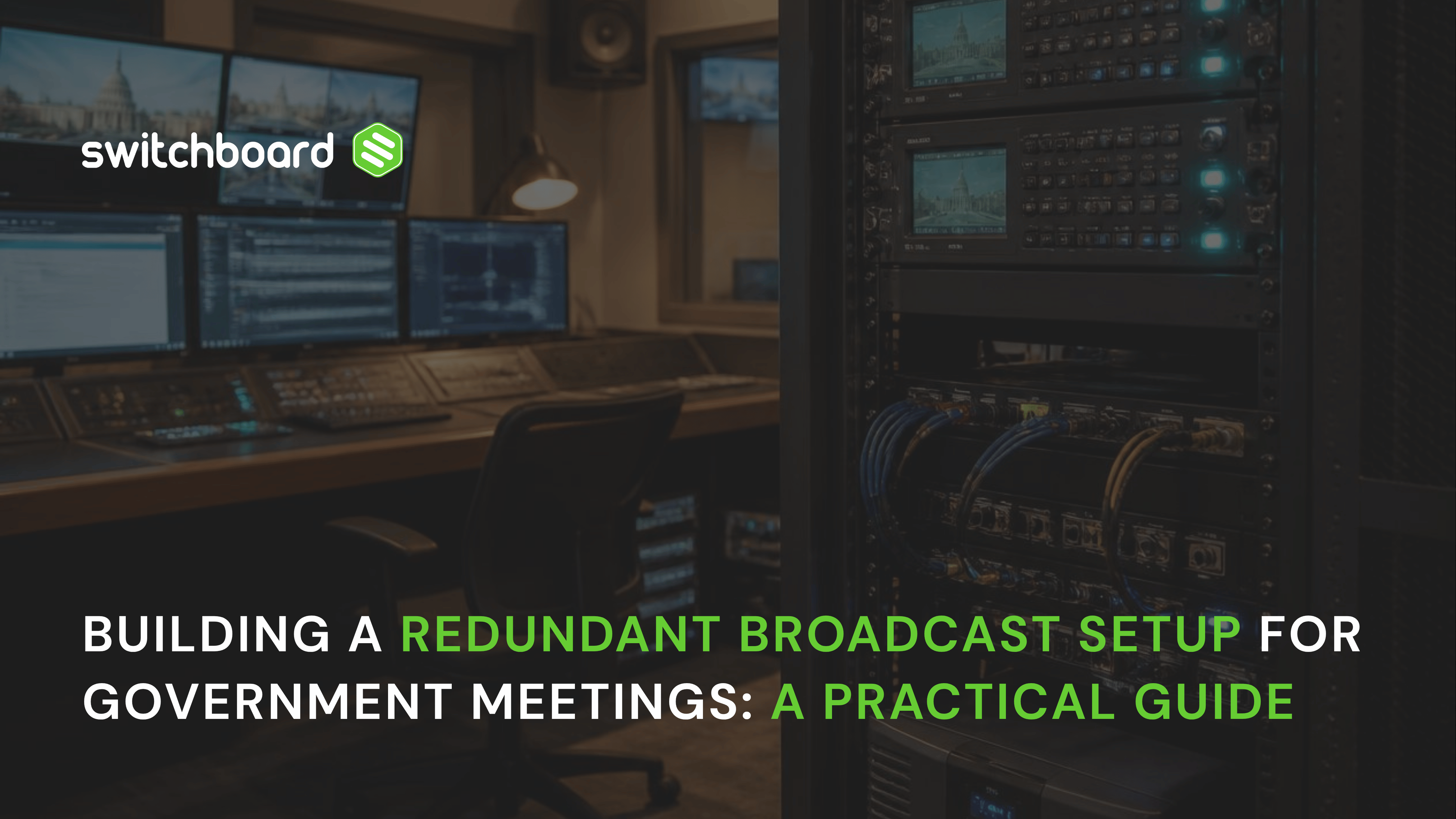
Equipment and processing. This is the layer people think of first, and it's about duplicating the actual hardware in your signal path: encoders, decoders, switchers. A secondary encoder or backup capture device means a single piece of failed hardware doesn't take your entire broadcast down mid-meeting.
Timing and synchronization. This one gets missed constantly. Long meetings, a multi-hour zoning hearing, a budget session that runs late, can drift out of sync between video, audio, and captioning over time if your system relies on a single timing reference. But that drift isn't just an annoyance, it degrades both accessibility compliance and the accuracy of your public record.
Power and physical infrastructure. Uninterruptible power supplies, dual utility feeds, separate circuits, backup generators. This layer keeps your equipment running through the kind of regional power event that has nothing to do with your broadcast setup at all, but takes it down anyway.
One Easy, High-Value Fix: Isolate Your Encoder From the City Network
Here's a piece of advice that's simple to implement and gets overlooked constantly: keep your streaming encoder off your primary municipal network domain.
When an encoder lives on the general city network, it becomes subject to the same IT security policies as every other device in your building, restrictive group policies, unexpected firewall rule pushes, or a forced off-hours reboot scheduled by an entirely different department that has no idea a meeting is streaming that night. None of those things are broadcast problems. All of them can take a live meeting offline anyway.
Putting your encoder on an isolated network segment removes it from that blast radius entirely, without requiring new hardware or a major infrastructure project.
Why This Isn't Optional
Open meeting laws, like California's Brown Act and similar statutes across the country, don't just encourage reliable public access. In many states, they legally require it. If a technological disruption prevents the public from watching or commenting during a meeting where remote access is legally mandated, the body generally has to stop taking action until access is restored.
The consequences of getting this wrong are not hypothetical. Under California Government Code Section 54960.1, an interested party or district attorney can demand that a legislative body "cure and correct" an action taken in violation of open meeting requirements, typically within 90 days of the action (30 days if the issue involves agenda posting). If the agency doesn't fix it, a court can void the action entirely.
Courts have shown they will actually do this. In Desert Mountain Energy Corp. v. City of Flagstaff, the Arizona Court of Appeals declared the city's own litigation null and void in 2025 because the city council failed to properly ratify a closed-session decision in public within the required window. That case wasn't about a broadcast failure specifically, but it's a clear signal of how unforgiving courts are about procedural compliance in open meeting law, the same doctrine that applies when a meeting continues improperly during a lost broadcast.
The financial stakes compound quickly. If a city council is voting on a bond issuance, a major zoning variance, or an infrastructure contract when the broadcast fails, a voided vote can delay the project by months, introduce interest rate risk on financing, and expose the city to claims from developers or vendors who relied on a decision that no longer legally exists. A redundant encoder or a backup network path costs a fraction of what a single voided vote can trigger.
Accessibility compliance adds another layer. Since April 2024, the Department of Justice requires WCAG 2.1 Level AA as the technical standard for public entity digital content, including live video, under ADA Title II. Live broadcasts specifically need real-time, accurate captions, not something added after the fact. Large jurisdictions (50,000 or more residents) have until April 26, 2027 to comply; smaller jurisdictions and special districts have until April 26, 2028. Civil penalties for a first violation can reach $115,231, rising to $230,464 for repeat violations, figures that adjust annually for inflation.
A Practical Redundancy Self-Assessment
None of this requires an unlimited budget or a total infrastructure overhaul. It requires an honest look at where your current setup shares a single point of failure, and closing those gaps one layer at a time.
Frequently Asked Questions
What does "redundancy" actually mean for a municipal broadcast setup? Redundancy means architectural diversity, not simple duplication. Two identical systems can fail from the same power surge or network outage. Real redundancy spreads risk across four layers: signal and transport, equipment and processing, timing and synchronization, and power and physical infrastructure.
Can a dropped livestream actually invalidate a city council vote? In jurisdictions where remote public access is legally required, yes. If a technical disruption prevents the public from watching or commenting, the meeting generally must stop taking action until access is restored. Courts have voided government actions over open meeting law violations, so the legal risk is real, not theoretical.
Why should I isolate my streaming encoder from the city's main network? An encoder on the general municipal network is subject to the same IT policies as every other device, group policy changes, firewall updates, or scheduled reboots, that can take a live broadcast offline for reasons that have nothing to do with the broadcast itself. Isolating it on its own network segment removes that risk without new hardware.
What are the ADA requirements for live-streamed government meetings? Since April 2024, the Department of Justice requires WCAG 2.1 Level AA compliance for public entity digital content under ADA Title II, including real-time, accurate captions on live video. Large jurisdictions must comply by April 26, 2027; smaller jurisdictions and special districts have until April 26, 2028.
Is it enough to have a backup encoder if it's connected to the same network as the primary? No. If both the primary and backup share the same power circuit or network path, they can fail together. True redundancy requires diversity at each layer, not just a spare unit sitting next to the original.