The right match makes all the difference. It's not about having the perfect partner, but one that is right for you and works well with others—I'm talking, of course, about the technologies you use every day to steer your communications and connect with your audience.
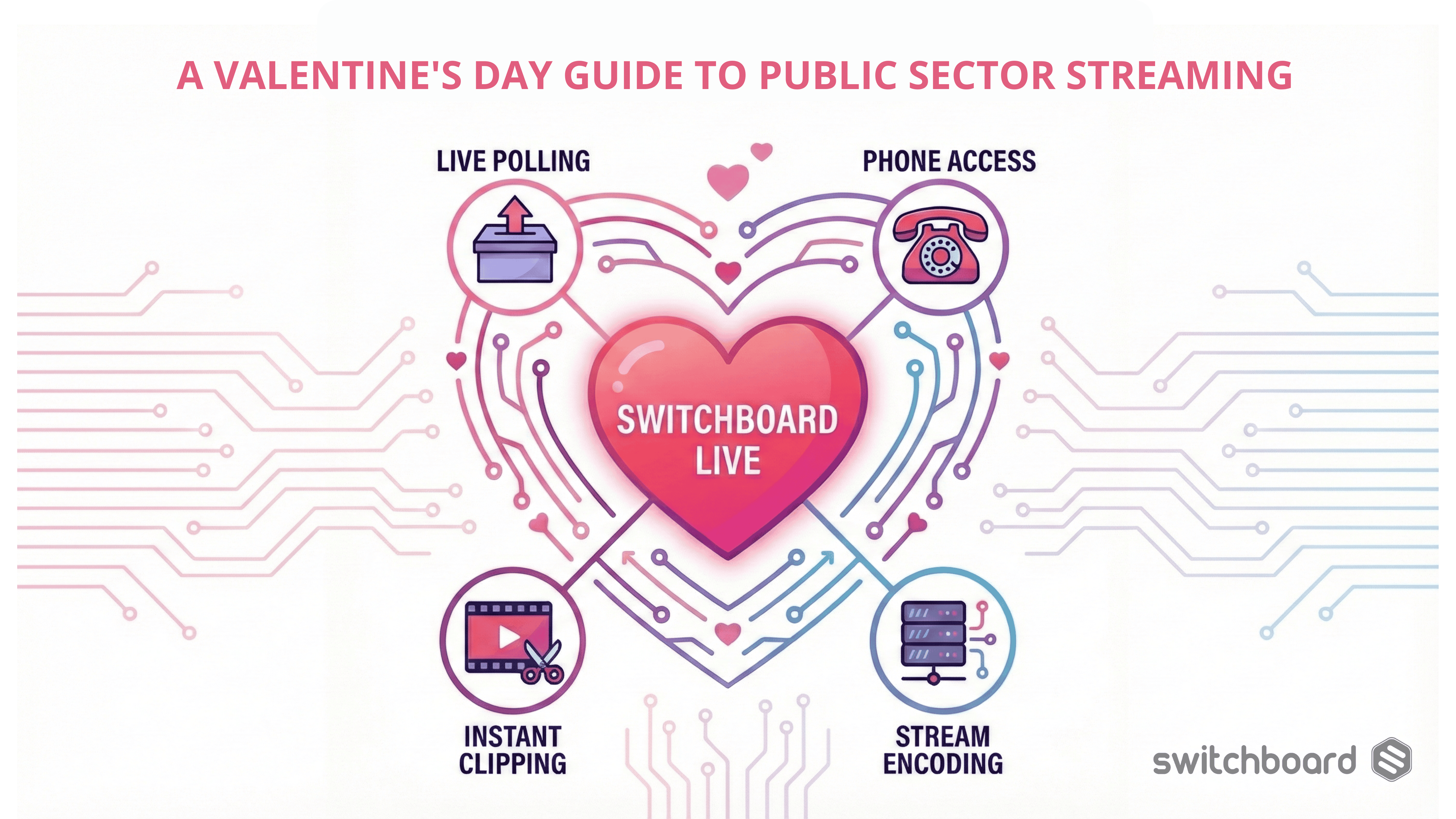
This year, in the spirit of finding your perfect pair, we've prepared a guide to help you find the best match to achieve great livestreams and community engagement.
What You're Looking For: Real-time Constituent Feedback
The Match: Interactive polling tools like Jotto
Picture this: Your city council is debating a new park location. Instead of wondering what residents think or following up post-event, you display a QR code in your stream. Viewers scan, vote, and voilà: you're seeing real-time sentiment from constituents who would never have driven to City Hall on a Tuesday night. This data is easy to analyze, categorize, and act upon.
Passive viewing becomes active participation. You transform "we have to let them watch" into "we want to hear from them." Overlay the QR code using your encoder (like OBS), and constituents engage without leaving the stream.
What You're Looking For: True Accessibility
The Match: Telephonic access to streams, like PhoneLive
Not everyone has reliable broadband. In fact, nearly 25 million people living in rural America lack reliable internet access. In other cases, some residents may be more comfortable dialing in than working on a computer or smartphone. Others might be joining during a service disruption.
Picture this: A rural county board meeting where 30% of public comments come via phone line, not video. These aren't "less engaged" residents—they're farmers calling from tractors, working parents on lunch breaks, and elderly constituents for whom dialing in is simply more practical than navigating a web interface.
True accessibility means meeting people where they are, with the technology they already have in their hands.
What You're Looking For: Content That Lives Beyond the Stream
The Match: Recording and clipping tools, like Snapstream
Most residents won't watch your full six-hour board meeting. But they will watch a 90-second clip about the issue affecting their neighborhood.
Real-time clipping lets you capture key moments as they happen—contentious votes, major announcements, emotional public comments—and instantly share them on social media, with local news partners, or on your website.
Think about making your content digestible. One poignant clip has the potential to reach more people than one long event ever will.
What You're Looking For: Professional Credibility
The Match: Encoding software like OBS, vMix, or Wirecast
While streaming with basic equipment is just fine if that fits your needs, more professional streaming with lower-thirds, agenda displays, and smooth transitions is a welcome (and sometimes necessary) upgrade for your streaming setup, especially when communicating information that will impact the lives of your constituents.
Picture this: A mid-sized city moves from webcam streaming to a simple three-camera setup with OBS. They are now able to add overlay visuals, CTAs, and other audiovisual elements to their streams, making events even more engaging for the audience. As a result, meeting viewership triples, and local media starts regularly pulling clips because the feed looks broadcast-quality.
Much like in social media (or the dating apps), we are competing for attention with everything. Professional, high-quality presentation signals that your city's team is prepared, and that the information they are sharing is highly valuable.
The Universal Match: Multistreaming Platforms
While these tools are brilliant on their own, none of them achieve connected communities on their own. But there is one connecting link that brings them all together and creates true, far-reaching results: multistreaming.
Multistreaming platforms, like Switchboard Live, Restream, or OneStream, act as universal connectors, bringing everything together. They allow you to:
- Send your professional OBS feed to YouTube and Facebook and your website simultaneously
- Add a Jotto QR code overlay while also streaming audio via phone line
- Archive your video while recording clips in Snapstream
- Do all this without multiplying your bandwidth requirements or technical complexity
Multistreaming is the friend who is with you when you are single, while you're searching for the perfect match, and who stays no matter what. It is a reliable streaming partner that you can complement with other technologies, or use on its own for its unique benefits (like reaching 10X your usual audience by streaming to multiple platforms at once, or connecting to a partner's stream, or even scheduling your events ahead of time).
Breaking Up With Technology That Doesn't Serve You
As you review your streaming relationships, look out for these red flags that your current setup is not working:
Launching a stream requires three staff members and 45 minutes. It shouldn't. Livestreaming your events should take a few minutes at most. You need that time to focus on the content, not the setup.
Constituents email saying "I couldn't join the meeting." That's system failure, not user error. Evaluate where users are dropping and where this issue is coming from. Is it a technology issue? A connection? Is accessing your events too complex?
Only one person knows how it works. Danger zone! If only one person can understand and run your streaming technology, you don't really have a system; you have a dependency and a critical problem waiting to happen. Your streaming technologies should be intuitive and require little training. Ideally, even a volunteer should be able to set up and start streaming.
Creating Your Streaming Love Story and Finding Connection
Community connection, that is. The best streaming technologies are not only about the tech working seamlessly, but also about connecting you to:
- The working parent who can finally attend planning commission meetings after their kids are asleep
- The disability rights advocate who no longer has to choose between physical pain and civic participation
- The rural resident who doesn't have to drive 90 minutes each way to watch a 12-minute vote
Your streaming stack should be an invisible infrastructure that makes democracy accessible. When it works right, people don't notice the technology, but they will note that they can finally participate in their community.
.png)