TL;DR
For municipalities, digital broadcasting is a legal obligation before it is a communications strategy. ADA requirements, WCAG 2.1 standards, and Sunshine Laws govern how public meetings must be conducted, recorded, and made accessible. Getting this right protects your community from legal exposure and creates the conditions for genuine civic inclusion.
- Sunshine Laws in all 50 states require public meetings to be noticed, accessible in real time, and fully documented
- California's SB 707 (2025) mandates hybrid meeting formats, real-time captioning, and multilingual agendas for eligible municipalities by July 1, 2026
- WCAG 2.1 AA is now federal law for government websites — large jurisdictions must comply by April 24, 2026
- ADA non-compliance fines start at $115,231 per violation; average settlements now run $125,000 to $200,000
- Municipalities investing in accessible hybrid broadcasting consistently report higher civic participation and stronger public trust
For municipal clerks, city managers, and IT administrators, digital broadcasting sits at the intersection of public service and legal obligation. The same technology that extends civic participation to working parents, people with disabilities, and residents in rural areas also carries specific, binding requirements under federal and state law.
Compliance here is not a bureaucratic hurdle. It is the mechanism through which accessibility becomes real. When municipalities get it right, more residents participate, decisions carry greater legal weight, and the community builds the documented engagement record that matters for grant funding and public trust alike.
The Foundation: What Sunshine Laws Actually Require
Every state in the United States maintains open meeting laws designed to guarantee public access to government decision-making. Florida's Sunshine Law, Indiana's Open Door Law, California's Brown Act, and Ohio's Open Meetings Act all share the same core obligations: public meetings must be properly noticed, accessible in real time, and meticulously documented.
Ohio's framework goes further than most, granting citizens an explicit statutory right to monitor elected officials and access government records, supported by mandatory training and comprehensive legal guidance published in what the state calls the "Yellow Book." Open meeting laws have existed in all 50 states since 1976, and while the pandemic temporarily relaxed enforcement, those temporary allowances have expired. Hybrid meeting formats are now a permanent expectation in most jurisdictions, and the legal requirements governing them have been tightened accordingly.
The practical implication for digital broadcasting is significant. A livestream of a public meeting is not simply a convenience feature. Under Sunshine Laws, it is part of the official record. Every motion, roll call, and public comment must be captured accurately and retained according to the jurisdiction's public records schedule.
The Legal Risks of Incomplete Records
The most significant area of legal exposure for municipalities is an incomplete or inaccurate digital meeting record. For a municipal vote, zoning change, or budget decision to be legally defensible, the record must capture every participant, every motion, and every public comment in full.
When a platform fails to record a virtual participant properly, or when a chat function is not managed in accordance with public records retention requirements, the decisions made in that meeting can be legally challenged and nullified. The City of Cleveland addressed this risk directly by adopting a social media policy that defines digital content explicitly as public records, including subscriber lists, posted comments on official streams, and even moderated deleted content, all subject to strict retention laws.
SB 707 and the New Standard for Hybrid Meetings
California's SB 707, signed into law in 2025, represents the most detailed legislative update to hybrid meeting requirements in the country and sets a standard other states are watching closely. By July 1, 2026, eligible legislative bodies including city councils serving populations over 30,000 must meet a substantially higher bar.
Under SB 707, in-person-only meetings are no longer compliant. Agencies must offer a hybrid format where remote participants have the same opportunity to provide real-time public comment as those attending in person, subject to the same time limits. View-only streaming no longer satisfies the requirement. The law also mandates real-time subtitling for any meeting that is broadcast or livestreamed, making live captioning a legal requirement rather than a best practice. Additionally, agencies must publish meeting materials online in advance and translate agendas into any language spoken by 20% or more of the applicable population that speaks English less than "very well," effective July 1, 2026.
What ADA and WCAG 2.1 Require in Practice
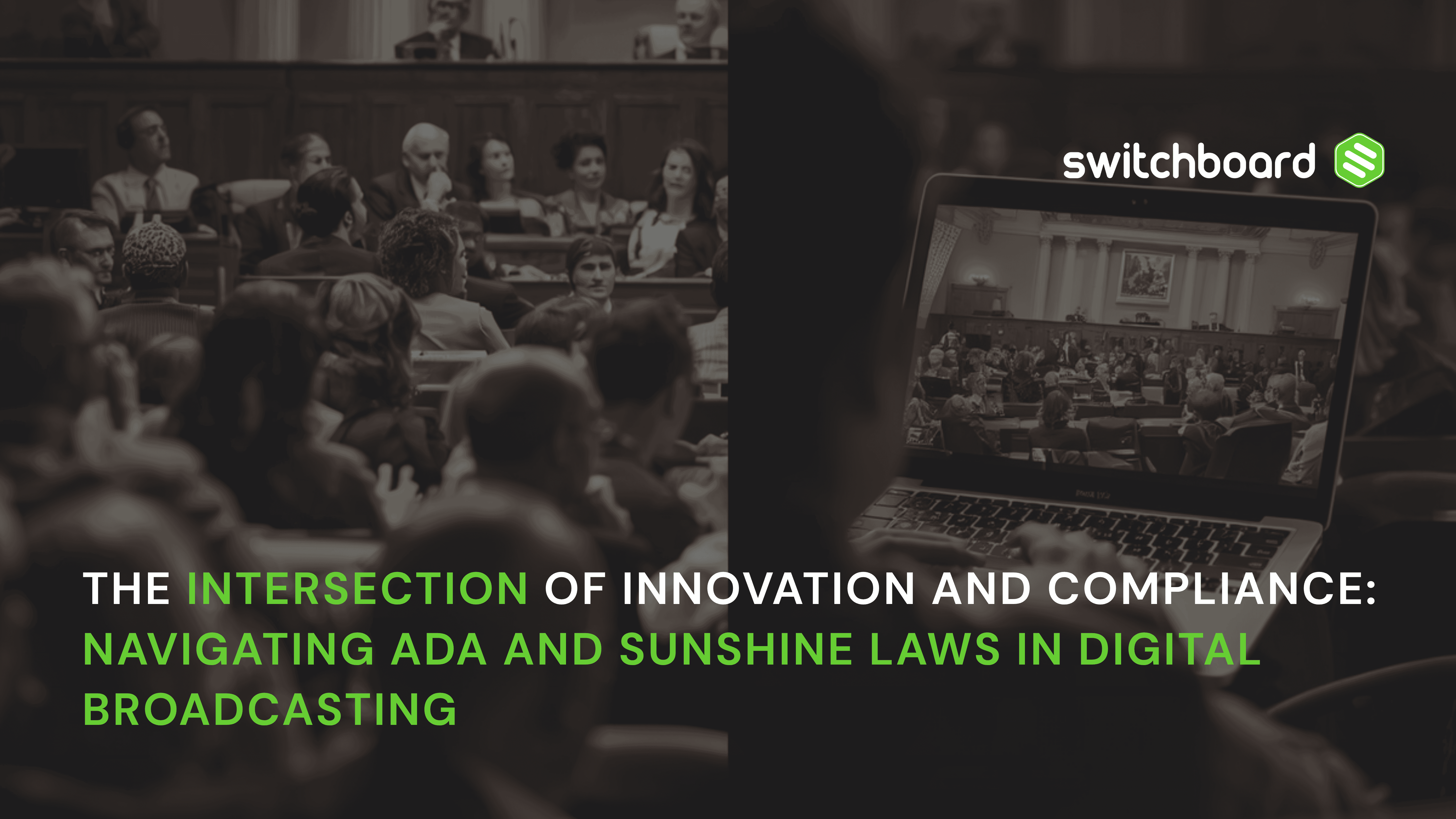
In April 2024, the Department of Justice published its final rule under Title II of the ADA, establishing WCAG 2.1 Level AA as the mandatory technical standard for all government websites, web content, mobile applications, and digital documents. This is federal law, not a recommendation. Standard consumer-grade video conferencing tools frequently fail to meet these requirements, creating legal exposure for any municipality that relies on them for public meetings.
In practical terms, municipal livestreams must meet several specific technical requirements. Real-time live captioning is mandatory. Providing archived video with auto-generated captions added after the meeting does not satisfy ADA requirements for real-time, equitable participation. Meeting agendas, slide decks, and digital materials must be fully machine-readable; standard scanned PDFs are inaccessible to screen-reading software and constitute a compliance violation. Municipal staff must also verbally describe all visual aids presented during a stream and read public chat questions aloud for the official record.
Agencies are also required to offer multiple methods for public comment submission beyond the physical podium: online forms, email, SMS, and voicemail. The compliance picture is not simply about the technology used to stream. It extends to every touchpoint through which a resident interacts with the meeting.
What Compliance Looks Like When It Works
Compliance is the floor, not the ceiling. Municipalities that have moved past minimum requirements and invested in genuinely accessible hybrid broadcasting are seeing measurable returns in civic participation.
The National League of Cities documented a consistent pattern across localities that adopted hybrid formats: more opportunities for community participation, improved access for residents with disabilities, and greater flexibility for council members. Compliance, in practice, produces the conditions that make genuine inclusion possible.
Building a Compliance-Ready Broadcasting Infrastructure
Relying on generic software and paper sign-in sheets leaves municipalities exposed to compliance failures on multiple fronts simultaneously. Purpose-built civic broadcasting platforms address this by automating WCAG compliance requirements, synchronizing multi-channel public comments to specific agenda items, and generating auditable digital records that satisfy Sunshine Law documentation requirements.
The technical checklist for a compliant municipal broadcast covers real-time captioning, screen-reader-compatible materials, multi-channel comment infrastructure, multilingual access, and complete record retention. Each of these requirements has a legal basis. Each also has a practical benefit: a meeting that is genuinely accessible to residents with disabilities, residents who work during business hours, and residents whose first language is not English, is a meeting that produces more representative community input.
The municipalities facing the steepest remediation costs in 2025 were not those that ignored compliance strategically. They were those that delayed because the problem felt abstract. ADA enforcement against government entities increased 30 to 40 percent annually between 2011 and 2024. With 8,800 federal ADA lawsuits filed in 2024 alone and a 37% surge in filings through the first three quarters of 2025, the enforcement trend is clearly accelerating. Waiting for a complaint is substantially more expensive than building a compliant infrastructure from the start.
At Switchboard Live, we build for the reality municipal teams work in: lean staff, strict legal requirements, and a community counting on every broadcast to work. Technology should connect your community, not create legal liabilities.
Frequently Asked Questions
What are Sunshine Laws and how do they apply to municipal livestreaming? Sunshine Laws, or open meeting laws, exist in all 50 states and require that public meetings be properly noticed, accessible to the public in real time, and fully documented. When a municipality livestreams a public meeting, that stream becomes part of the official legal record. Every motion, roll call, and public comment must be captured accurately and retained according to the jurisdiction's public records schedule. Incomplete digital records can render decisions legally challengeable.
What does WCAG 2.1 compliance require for government websites and livestreams? The Department of Justice's April 2024 final rule established WCAG 2.1 Level AA as the mandatory standard for all state and local government websites, web content, mobile applications, and digital documents. For livestreams specifically, this includes real-time captioning, screen-reader-compatible meeting materials, and accessible public comment channels. Large jurisdictions (50,000+ population) must comply by April 24, 2026. Smaller jurisdictions have until April 26, 2027.
What are the financial consequences of ADA non-compliance for municipalities? ADA fines adjusted for inflation in 2024 now start at $115,231 for a first violation and reach $230,464 for subsequent offenses. Average municipal ADA settlements ran $125,000 to $200,000 as of late 2025. Emergency remediation costs typically run three to four times the cost of proactive compliance. More than 142 municipalities have been named in digital accessibility lawsuits since 2011, and the pace of enforcement is accelerating year over year.
What does California's SB 707 require for public meetings? California's SB 707, signed in 2025, requires eligible legislative bodies (including city councils serving populations over 30,000) to offer hybrid meeting formats by July 1, 2026. View-only streaming is no longer sufficient. Remote participants must have the same real-time public comment rights as in-person attendees. The law also mandates real-time subtitling for all broadcast or livestreamed meetings and requires agendas to be translated into any language spoken by 20% or more of the applicable limited-English-proficient population.
Does investing in accessible hybrid meetings actually increase civic participation? Yes, consistently. The National League of Cities documented that municipalities adopting hybrid formats report more community participation, better accessibility for residents with disabilities, and greater flexibility for elected officials. Greenfield, Massachusetts published 70 more meetings publicly in 2024 than in 2023 after expanding its hybrid infrastructure. Milford, Massachusetts saw hybrid meeting adoption drive higher attendance at subsequent events. Compliance and participation are not in tension — accessible infrastructure produces both.
.png)