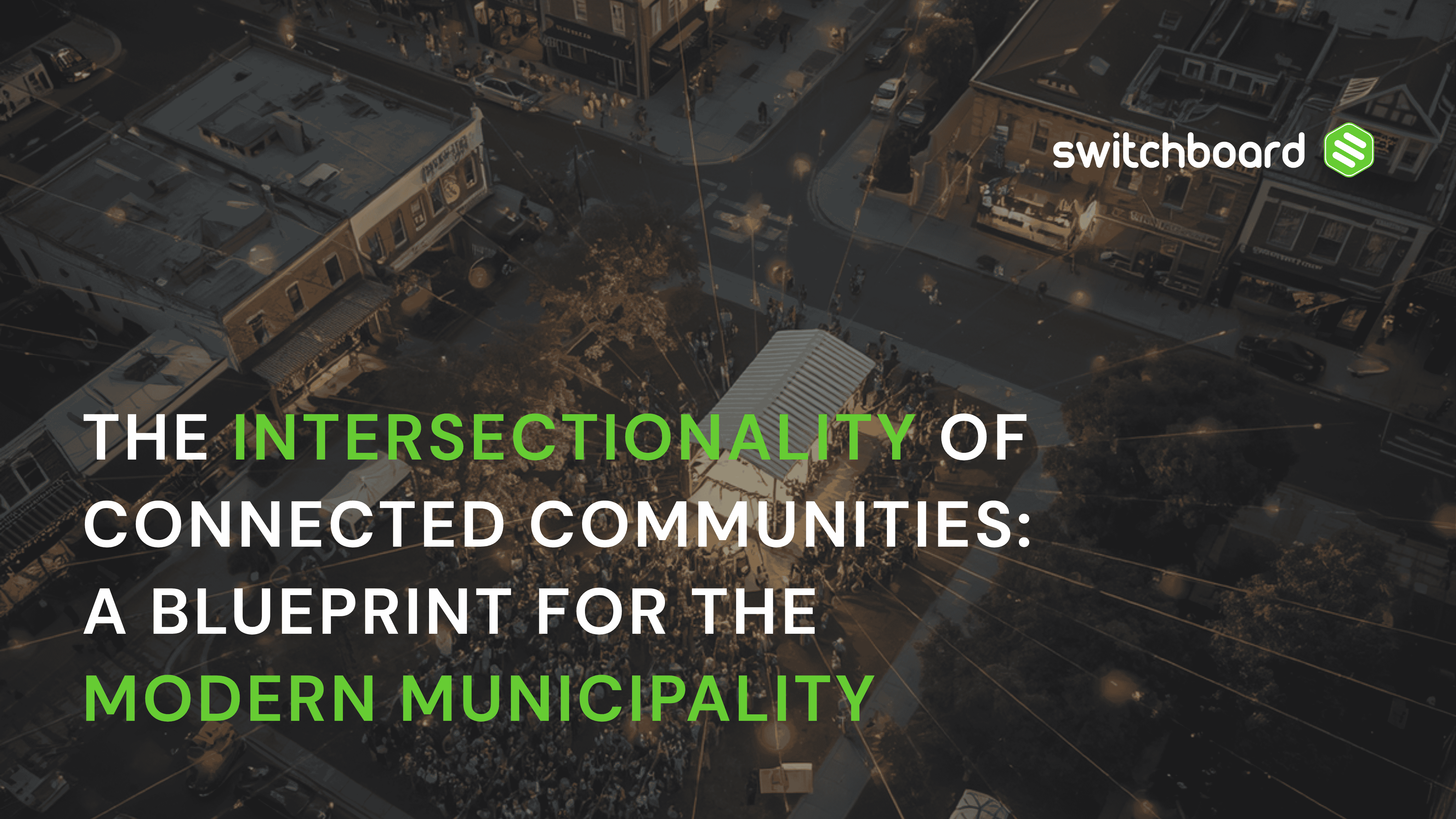
Imagine a bustling downtown civic event on a Saturday afternoon: the local high school band is playing, small business vendors are selling out of their artisan goods, and city council members are shaking hands with constituents. It’s the picture-perfect image of a healthy, vibrant municipality.
But behind this physical success story lies a hidden, digital-first engine.
For the modern municipality, bridging the online and offline divide is the fundamental blueprint for growth. At Switchboard Live, we have observed a powerful phenomenon: connecting real-life events to the digital world through multichannel livestreaming triggers a massive, intersectional cascade of benefits. Recognizing the value of digital inclusion directly fuels physical attendance at community events, which in turn drives economic prosperity and positions your city as a top contender for investment and federal grant funding.
That is the trickle-down effect of the connected community.
Inclusion Beyond the Baseline
Transparency in local government is a legal baseline. Across the United States, open meeting mandates and Sunshine Laws require public meetings to be documented and accessible. But as any city clerk will tell you, a physically open door doesn't guarantee a full room.
The National League of Cities (NLC) points out that making public meetings truly accessible means addressing systemic barriers. Physical attendance at a civic meeting requires a number of resources—transportation, time flexibility, and physical mobility, to name a few. These requirements represent a luxury often unavailable to constituents with demanding schedules, people with disabilities, the elderly, or those caring for children or family members. ADA compliance in the digital age means ensuring that citizens with impairments are not disenfranchised by physical constraints; however, accessibility also offers new engagement opportunities to other previously underserved demographics.
When governance only happens in physical rooms, municipalities inadvertently exclude critical voices. Implementing user-friendly multichannel broadcasting changes that paradigm. By simulcasting city council meetings and town halls, cities move past basic legal compliance and achieve genuine, equitable digital inclusion, giving working parents, second-shift workers, and differently-abled citizens a permanent seat at the table.
The Digital-to-Physical Engagement Pipeline
A common misconception regarding digital adoption is the fear of cannibalization: "If we stream the downtown festival, no one will actually show up in person." In reality, digital reach is the ultimate driver of physical engagement.
"If we stream the downtown festival, no one will actually show up in person."
Different demographics gravitate toward different platforms. The constituent base actively using Facebook is entirely different from the younger demographics on Twitch, YouTube, or X. Jessica Battista, Digital Communication Coordinator for the City of Hardeeville, is dedicated to maximizing community outreach through any and all channels necessary.
“Our goal is to keep residents informed, connected and engaged through a mix of timely updates and community storytelling,” Battista said.
As she highlights, cities must communicate strategically by using different platforms to reach different audiences.
Multichannel livestreaming solves this fragmentation. Reaching diverse groups where they already are creates a potent sense of "fear of missing out" (FOMO). An engaged online audience shares clips, tags neighbors, and builds momentum that translates directly into a vibrant, physically present community at future municipal events. Thus, digital engagement is not a replacement for physical community; rather, it becomes the top of the funnel for it.

The Economic Engine and Civic Capital
Engaged communities are economically robust communities, and the integration of digital broadcasting directly amplifies these localized benefits.
When municipalities utilize multichannel platforms to showcase local programs and entrepreneurs—such as livestreaming a downtown cultural festival, an Art & Wine Walk, or a "shop local" campaign—they do more than just provide free advertising; they directly stimulate local commerce. By extending the reach of these events beyond the physical attendees, cities inject immediate velocity into the local economy.
The economic impact goes much deeper than a single weekend's sales. Research indicates that the proportion of residents who report a strong emotional attachment to their community serves as a highly predictive indicator of long-term economic growth. Simply put: individuals who care about their locale are statistically more likely to invest, spend, and hire within its borders. By broadcasting the civic and cultural lifeblood of the city to wherever constituents are, municipalities actively cultivate this vital emotional attachment.
Furthermore, high levels of civic participation serve as a massive green light to external investors. It signals that a community is collaborative, stable, and growth-oriented, making the municipality a highly attractive destination for capital investment.
Camp Hill Borough serves as a prime example of this dynamic in action. In Camp Hill, residents utilized accessible public hearings and advisory input to forge a complex zoning compromise. Because the community was highly engaged and informed, they successfully balanced aggressive economic growth initiatives with the preservation of their historic neighborhood character.
A Scalable Ecosystem, from Chicago to Main Street
Livestreaming as a communication medium is the visible tip of the spear, but it thrives best when integrated into a larger civic tech ecosystem. We are not saying that only because we provide a livestreaming solution: Harvard research on Smart City Solutions illustrates that building better cities requires leveraging civic technology to foster deeper trust between citizens and government.
Consider the dynamics observed in Chicago neighborhoods, where studies demonstrate that local and frequent interactions within civic boundaries efficiently spread information about job openings and business opportunities. When a city's digital infrastructure allows local government officials, business owners, and residents to effortlessly exchange viewpoints, it sparks collaborative ventures, new infrastructure projects, and business partnerships that directly drive economic expansion.
A truly scalable ecosystem also leverages these digital tools to shatter language barriers and expand the electorate. The city of Denver, Colorado, for example, utilizes advanced online platforms to automatically translate live civic meetings into English and Spanish by default, with the capability to simultaneously interpret up to five additional languages.
These examples illustrate a powerful reality: when local governments utilize digital streaming and communication tools to proactively accommodate diverse linguistic and physical needs, they fundamentally reshape the demographic makeup of their active electorate. They ensure that municipal decisions are informed by the entire community, rather than just an elite, highly mobile fraction.
One Simple Change. that Leads to Massive Impact.
Implementing multichannel broadcasting is no longer a complex, IT-heavy lift. Modern platforms let municipal staff distribute content across every major network—from local PEG stations to global social media platforms—in just a few clicks through remarkably intuitive technology.
Even one simple change—streaming your events—sets off an impactful chain reaction: more transparency, higher physical attendance, stronger local business visibility, and more competitive grant applications.
Over the next few weeks, we'll dive deeper into each of these pillars—Accessibility, Civic Engagement, Economic Welfare, and Connected Ecosystems—to explore how technology adoption combined with civic commitment can bring transformational changes to communities.
Ready to start building your connected community? Explore how Switchboard Live empowers municipalities to transform singular events into continuous, multichannel community engagement. Learn more about Switchboard Live.
Frequently Asked Questions
What is livestreaming for municipalities?
Multistreaming means broadcasting a single live event—such as a city council meeting, town hall, or community festival—simultaneously across multiple platforms like Facebook, YouTube, X, and Twitch. Tools like Switchboard Live make this possible without requiring dedicated IT staff or technical expertise.
Does livestreaming civic events reduce in-person attendance?
No — research and practitioner experience consistently show the opposite. Digital broadcasting creates awareness and FOMO that drives higher physical attendance at future events. Online viewers who feel connected to their community are more likely to show up in person, not less.
Do streaming to multiple social media platforms replace PEG Stations Programming?
Not at all. In fact, you can use livestream technology as an amplifier to your existing programming, premiering shows on both your PEG channel and YouTube/Facebook pages at the same time, sharing your content to an audience that may not have been able to tune-in through the traditional channels.
What platforms should municipalities stream to?
The best approach is streaming to wherever your community already is — typically Facebook for broad local reach, YouTube for archiving and SEO, and Twitch or X for younger or more civic-tech-forward audiences. If your website allows it, you may also stream video directly to your home or events page. Switchboard Live supports simultaneous multistreaming to all major platforms from a single dashboard, making it easy to manage all of your destinations without overwhelming your communication team.
Is multichannel livestreaming accessible to smaller municipalities?
Yes. Modern multistreaming platforms are built for non-technical users. A city clerk or communications staff member can manage a full omnichannel broadcast without IT support. The barrier to entry has dropped significantly in recent years, making technologies like these accessible to teams of all sizes and skill-sets.